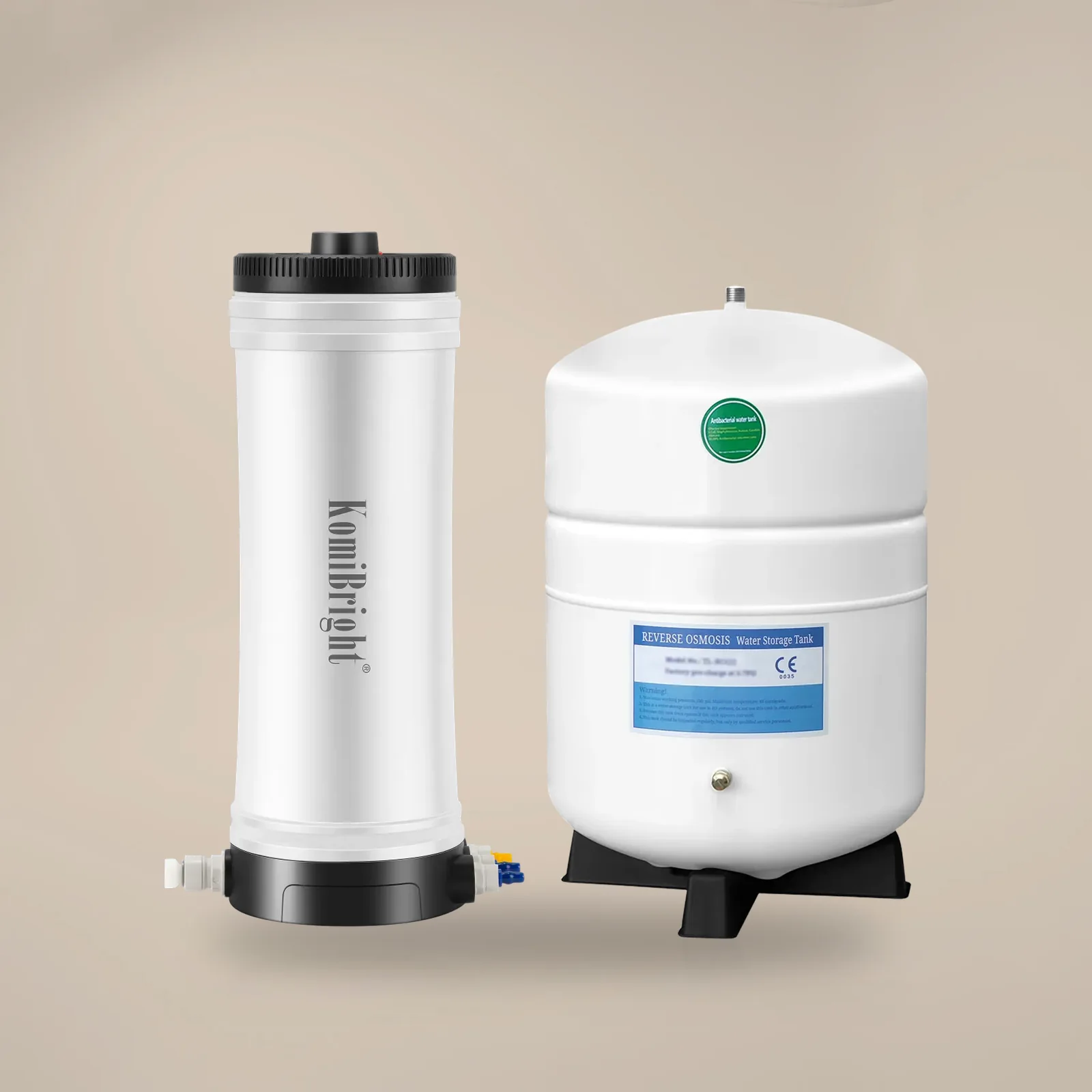
Most carbon filters are made one of two ways. The carbon is either pressed together with a plastic binder, or fused into a solid block in a furnace. In the housing the two look the same. In use they are not. KomiBright's C25R series uses sintered carbon.
How each one is made
- Compressed: carbon is kneaded together with a plastic binder and pressed into shape. The binder holds the block together, and in doing so coats part of the carbon it is holding.
- Sintered: fine carbon is bonded and fired until it holds together on its own. The finished block is carbon almost throughout.
Why it shows in the water
- More working carbon. Carbon takes out chlorine, taste and odour by holding them on its surface. Where plastic covers that surface, it cannot. A sintered block leaves more of it open to the water.
- A finer, winding pore network. Fine particles leave narrow, zigzag channels, so water stays in contact with the carbon for longer on its way through.
- No carbon dust. The block is one rigid piece, so loose carbon fines are not washed out into the first water from a new cartridge.
- No short cuts. Water cannot open an easy channel through a solid block and pass the carbon by, so all of it is filtered.
- More room for what it catches. A sintered block holds more dirt before it clogs.
At the end of its life
A block that is carbon throughout has no plastic binder to separate from it, which makes it easier to recycle than a bonded one. A binder is also the hardest part of a compressed block to regenerate, and the part that pollutes when the block is thrown away.
Where to find it
Sintered carbon is used across KomiBright's C25R under-sink series: the C25R, C25R Plus, C25RH and C25RP. Each model's page lists what ships in the box and how often its cartridges are changed.